
Twelve Things Worth Knowing About Bamboo (From People Who Build With It)
10. September 2026 · Von Crocodile Products
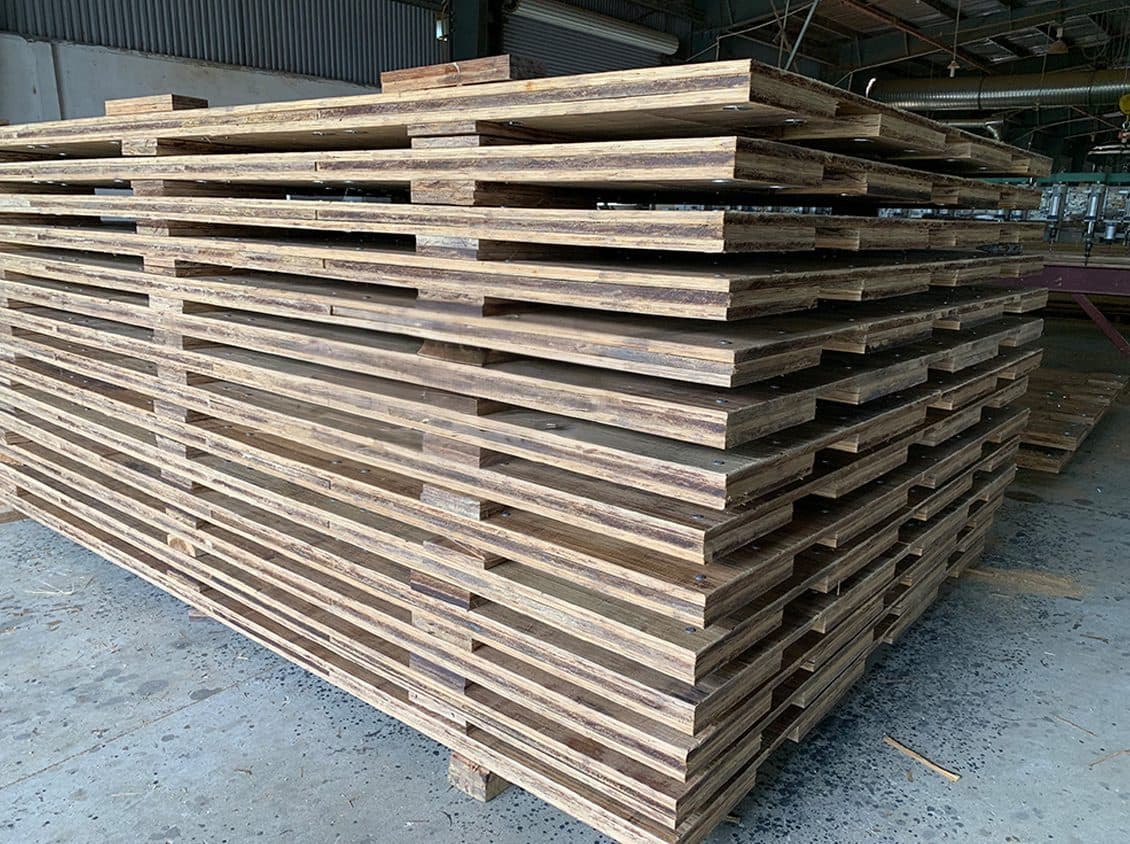
We make ground-protection mats out of bamboo, so we get the same first question a lot: isn't that grass? Yes. It is. And it is a far stranger and more capable plant than most people realise. Here are twelve things about bamboo that surprised us, with sources, and a couple of popular claims we deliberately left out.
The facts
01 It really is a grass.
Bamboo belongs to the grass family, Poaceae, in its own subfamily, Bambusoideae. There are more than 1,400 species across roughly 115 genera. Botanically it is closer to your lawn and to wheat than to the hardwood trees it competes with on a job site. The difference is what it does with that ancestry.
02 It holds the record for the fastest-growing plant on Earth.
Guinness World Records lists bamboo as the fastest-growing plant, with certain species putting on up to 91 cm (35 inches) in a single day. That is not a burst of leaves; it is the culm itself shooting upward. Stand next to one with a tape measure and you could watch the difference before lunch.
03 A culm reaches full height in one season, then spends years hardening.
A bamboo culm does its vertical growth in a matter of weeks and never gets taller or thicker after that. What happens next is the interesting part: the walls lignify and densify over the following years. That is why age at harvest matters so much. A culm cut too young is soft; one cut at maturity, typically somewhere in the three-to-seven-year window depending on species, is the material worth building with.
04 You harvest it without killing the plant.
Bamboo grows from an underground rhizome network. Cut a mature culm and the rhizome keeps producing new ones. A well-managed grove is harvested selectively every year, indefinitely, with no replanting. Compare that with a hardwood tree, which is harvested once and takes decades to a century to replace.
05 The giants are taller than most buildings you have worked in.
The largest bamboos are the largest members of the grass family. Guinness records tropical specimens around 40 m (130 ft); Dendrocalamus sinicus has been documented at 46 m (151 ft). A five-storey building is around 15 to 18 m.
06 It is hollow, and that is a feature, not a weakness.
A bamboo culm is a hollow tube divided by solid walls (nodes) at intervals. The load-carrying fibres run lengthwise in the culm wall and are packed most densely toward the outside skin, which is exactly where a hollow tube wants its material to be. It is the same logic as a scaffold pole or a bicycle frame. For an engineered mat, those fibres are stripped, resin-bonded and pressed, so the finished product is solid; but the raw material starts out as a very efficient natural structure.
07 Some species flower once in a lifetime, all at once, then die.
Many bamboos flower on a cycle measured in decades. The documented range runs from a few years to over 150 years for Bambusa vulgaris, and several Phyllostachys species run over a century. When a species flowers, it often does so gregariously: every plant of that lineage, across whole regions, seeds in the same year and then dies back, regenerating from seed or surviving rhizomes. Nobody has fully explained how the plant keeps time.
08 It lit the first commercial light bulbs.
In 1880 Thomas Edison's team, testing thousands of filament materials, found that carbonised bamboo from Yawata, near Kyoto, ran for about 1,200 hours. Bamboo filaments went into production bulbs from around 1881 and stayed there until 1894, when a better filament came along. For roughly thirteen years the modern electric light ran on grass.
09 Hong Kong still builds skyscrapers on bamboo scaffolding.
Walk past a high-rise under construction or renovation in Hong Kong and there is a fair chance the scaffold is bamboo, lashed by hand, wrapped around a tower of steel and glass. It is light, cheap, fast to erect and has been carrying construction crews up buildings for generations. The trade is a recognised skill with its own training and certification.
10 Vietnam is one of the world's great bamboo countries.
Vietnam has roughly 1.5 million hectares of pure and mixed bamboo forest, more than a tenth of its total forest area, with around 200 native species across more than 20 genera. The bamboo sector is estimated to employ, fully or partly, around 10 million people, and the country ranks among the top five exporters of bamboo and rattan products. Our mats are manufactured in Vietnam for a reason.
11 Bamboo is a non-wood forest product, and the EU agrees.
Under the FAO classification bamboo is a non-wood forest product, because it is a grass. That matters more than it sounds: from 30 December 2026 the EU Deforestation Regulation (EUDR) puts due-diligence obligations on timber, including the tropical hardwoods used in traditional mats, but products made exclusively of bamboo are outside its scope (European Commission FAQ v5, April 2026, §2.12). We wrote a whole piece on it.
12 A grass took over the job of a hardwood tree.
Strand-woven bamboo composite is what happens when you take those long, dense culm fibres, bond them with resin and press them under heat into a solid billet. The process turns a hollow grass stem into a dense, dimensionally consistent engineered material, manufactured to a specification rather than sawn from whatever the tree happened to be. That consistency, not a magic number, is the reason it works as a mat.
Two things you'll read elsewhere that we won't repeat
"Bamboo is stronger than steel." Small bamboo specimens can post impressive tensile numbers along the grain, but comparing a fibre coupon with a structural steel section is not a comparison an engineer would accept, and it says nothing about how a finished mat performs under a crawler track. We test finished mats. Ask for the paper.
"Bamboo absorbs several times more carbon than trees" and other carbon claims. Growth rate and carbon accounting are different things, and a claim like this needs a verified life-cycle study behind it before anyone should publish it. We are not making that claim.
What we do with it
The plant is remarkable on its own. What we do with it is engineering, and engineering comes with documentation. If you want to know what bamboo actually does under load, moisture and fire, the FAQ is the next stop. Quote requests via crocodileproducts.com, answered within 24 hours.
Sources: Guinness World Records, "Fastest growing plant"; Zheng et al., "The Bamboo Flowering Cycle Sheds Light on Flowering Diversity", Frontiers in Plant Science, 2020; Government of Japan, "Highlighting Japan", August 2022, and the Yawata City Edison Monument; INBAR country profile for Viet Nam (2019 remote-sensing survey, employment and trade estimates); Regulation (EU) 2023/1115 and European Commission EUDR FAQ v5, April 2026, §2.12. Botanical figures cross-referenced to standard taxonomic references. Citations supplied on request.