
Kiln-Dried SYP vs Green Douglas Fir: What Actually Arrives on Your Site
26 oktober 2026 · Door Crocodile Products
Ask a Western Canadian mat buyer why the yard is full of Douglas Fir and the honest answer is usually availability, not performance. Douglas Fir is what the local mills cut, so it is what the mat shops build with. Southern Yellow Pine has been the standard access mat timber across the US Gulf Coast and the Southeast for decades, but it is harder to get north of the border, so most buyers here have never had a reason to compare the two.
We think the comparison is worth making, and we think the name of the wood is the least important part of it. The difference that matters is what is in the boards when the mat arrives on your site: water. This article sets out what we build, what green lumber means for a mat, how the two compare board for board, and where the published numbers stop and testing has to take over.
What we build: Hybrid 3-ply access mats
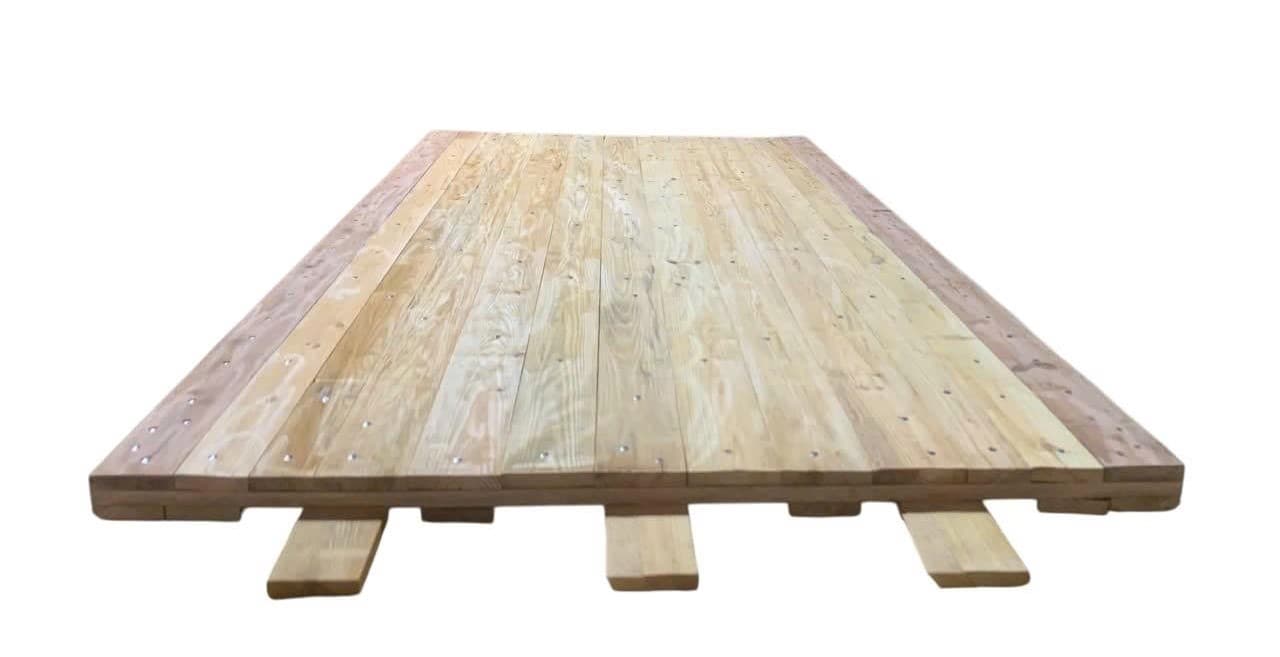
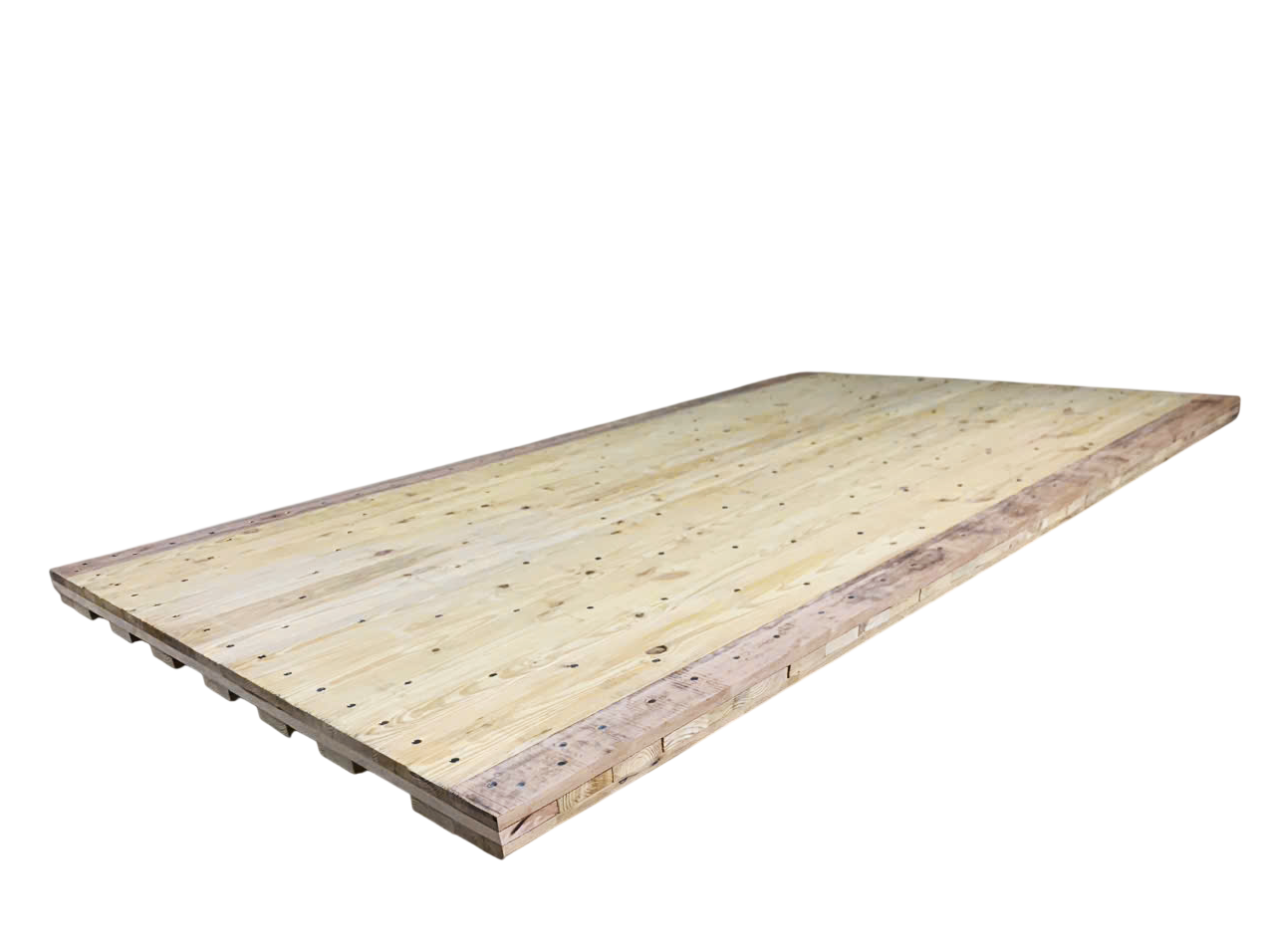
Our Hybrid 3-ply access mats are built from Southern Yellow Pine that is kiln dried to 12% moisture content or less before assembly, with hardwood edge boards on the outside where mats take the most abuse from forks, buckets and neighbouring mats. Each ply is 37 mm, for a 111 mm mat, in the standard 8 x 14 ft format.
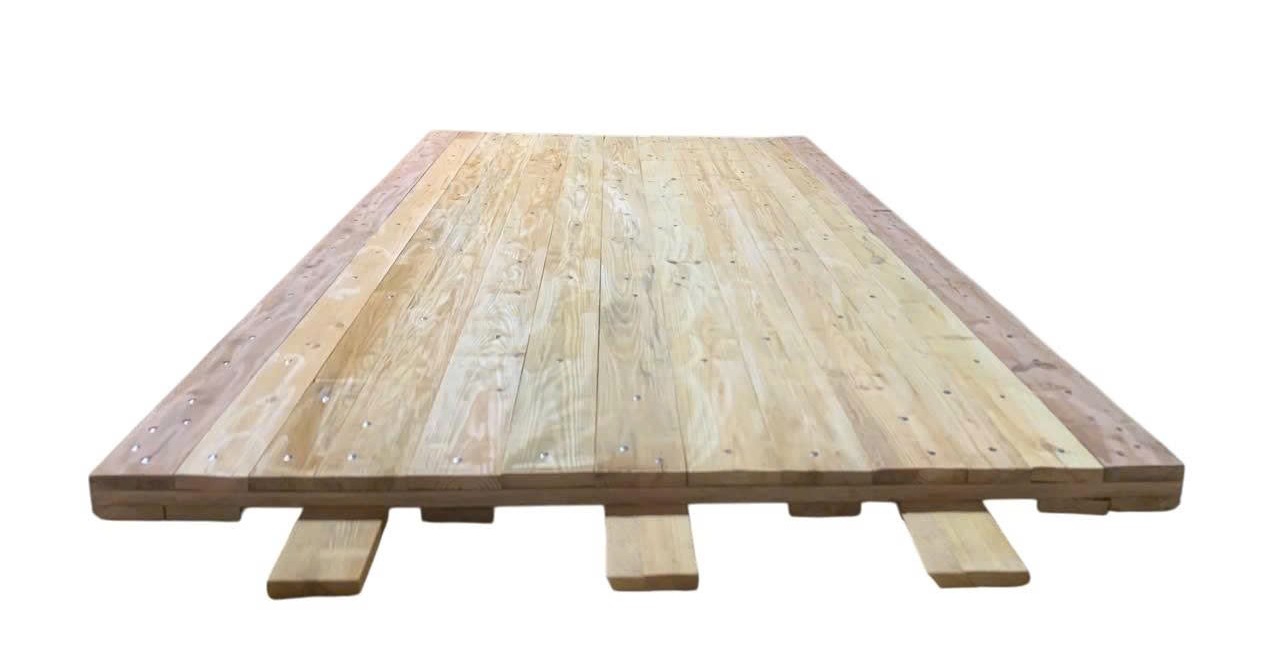
A Crocodile Hybrid 3-ply access mat: kiln-dried SYP through the body of the mat, hardwood edge boards on the outside.
What green means
Douglas Fir access mats are typically built from green 2x8 lumber. Green does not mean poor quality; it means the lumber has not been dried before it is nailed into a mat. Moisture content on green mat lumber typically runs from about 25% to 38%. The best-sourced Douglas Fir, from logs left to air dry in the bush before milling, lands at the low end of that range. Lumber from most other mills sits towards the top.
That number matters because of how wood takes on strength. Above roughly 24% moisture, the extra water sits in the cell cavities. It adds weight and adds nothing to strength. Only as the wood dries below that point do hardness, crushing resistance and bending strength begin to climb, and they keep climbing all the way down. A green mat at 25 to 38% has gained none of it yet.
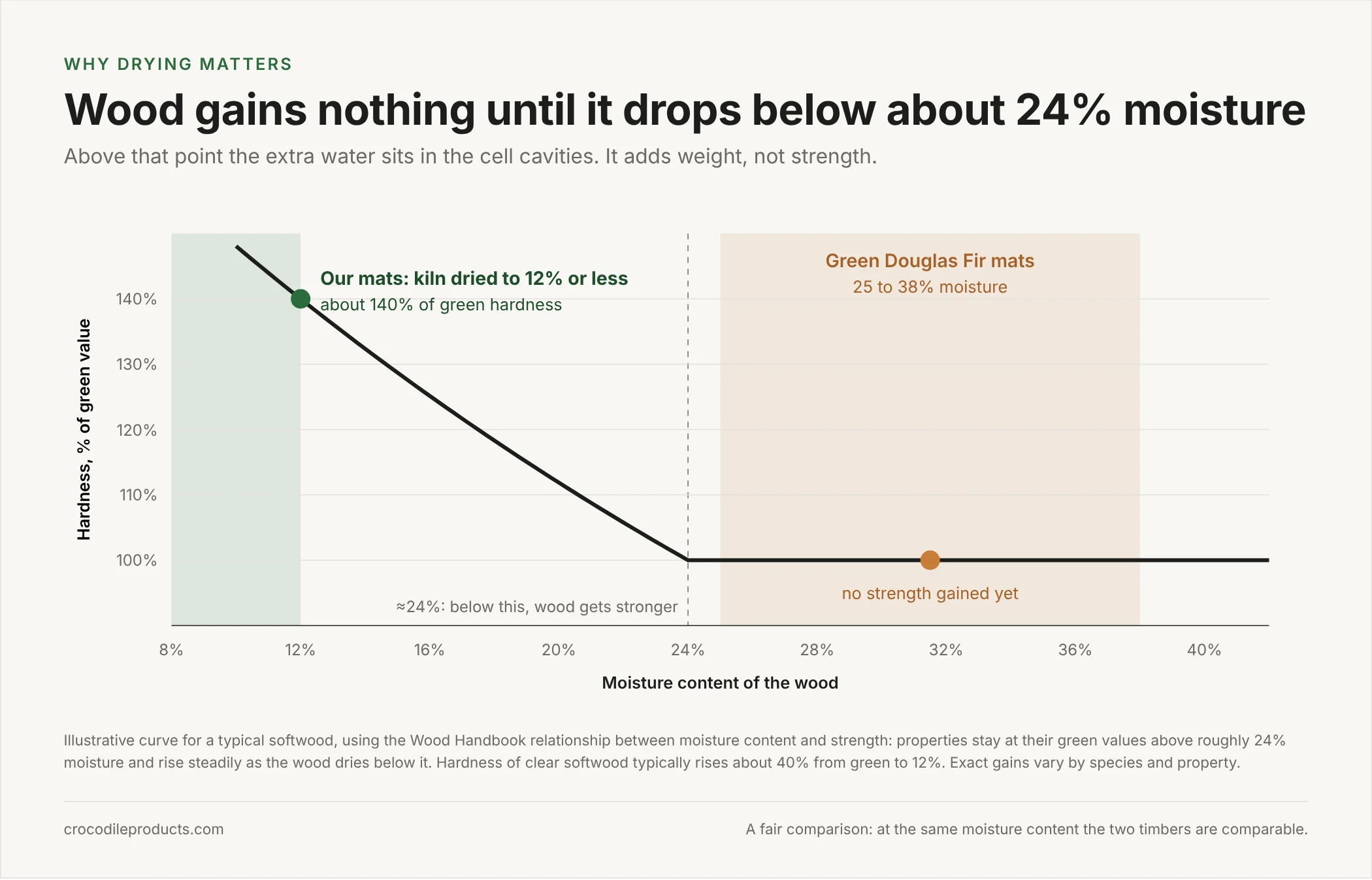
One point in fairness to Douglas Fir: at the same moisture content, the two timbers are comparable. Kiln-dried Douglas Fir is a fine timber. The advantage we are describing comes from delivering a dry, stable mat, not from the species on the label.
The numbers, board for board
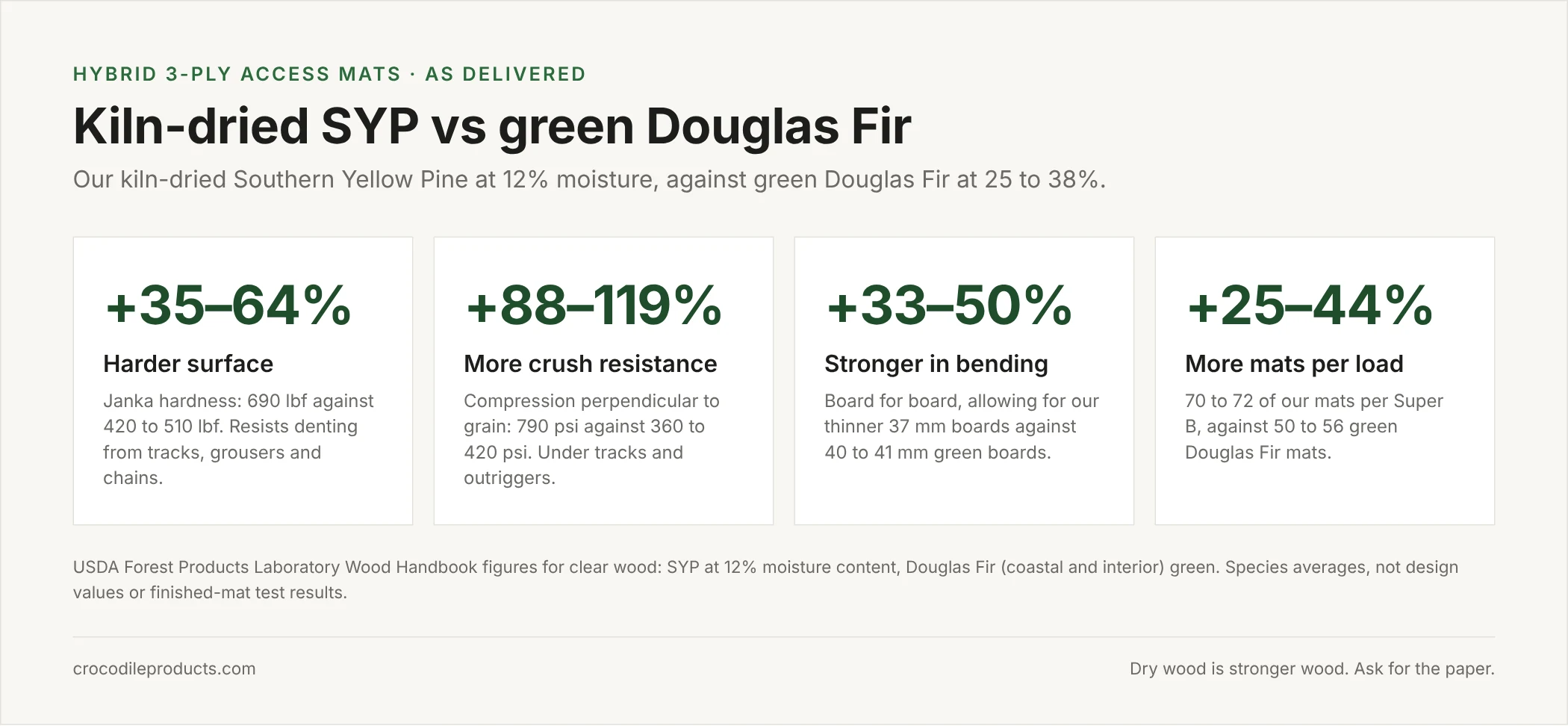
The figures below are published USDA Forest Products Laboratory Wood Handbook values: SYP at 12% moisture content, and Douglas Fir (coastal and interior) green. Because our boards are thinner than typical green Douglas Fir mat boards (37 mm against 40 to 41 mm), bending and shear are compared on the capacity of one board, not just the wood. Hardness and crushing resistance are surface properties and do not depend on thickness.
Property | Kiln-dried SYP (12% MC) | Green Douglas Fir (25 to 38% MC) | SYP advantage | Why it matters on site |
|---|---|---|---|---|
Janka hardness | 690 lbf | 420 to 510 lbf | +35 to 64% | Resists denting and wear from tracks, grousers and chains |
Compression perpendicular to grain | 790 psi | 360 to 420 psi | +88 to 119% | Resists crushing under tracks, outriggers and point loads |
Bending strength, board for board | 12,800 psi, 37 mm board | 7,400 to 7,700 psi, 40 to 41 mm board | +33 to 50% | Carries load when bridging soft ground |
Shear strength, board for board | 1,390 psi, 37 mm board | 900 to 950 psi, 40 to 41 mm board | +31 to 44% | Handles short-span heavy wheel loads |
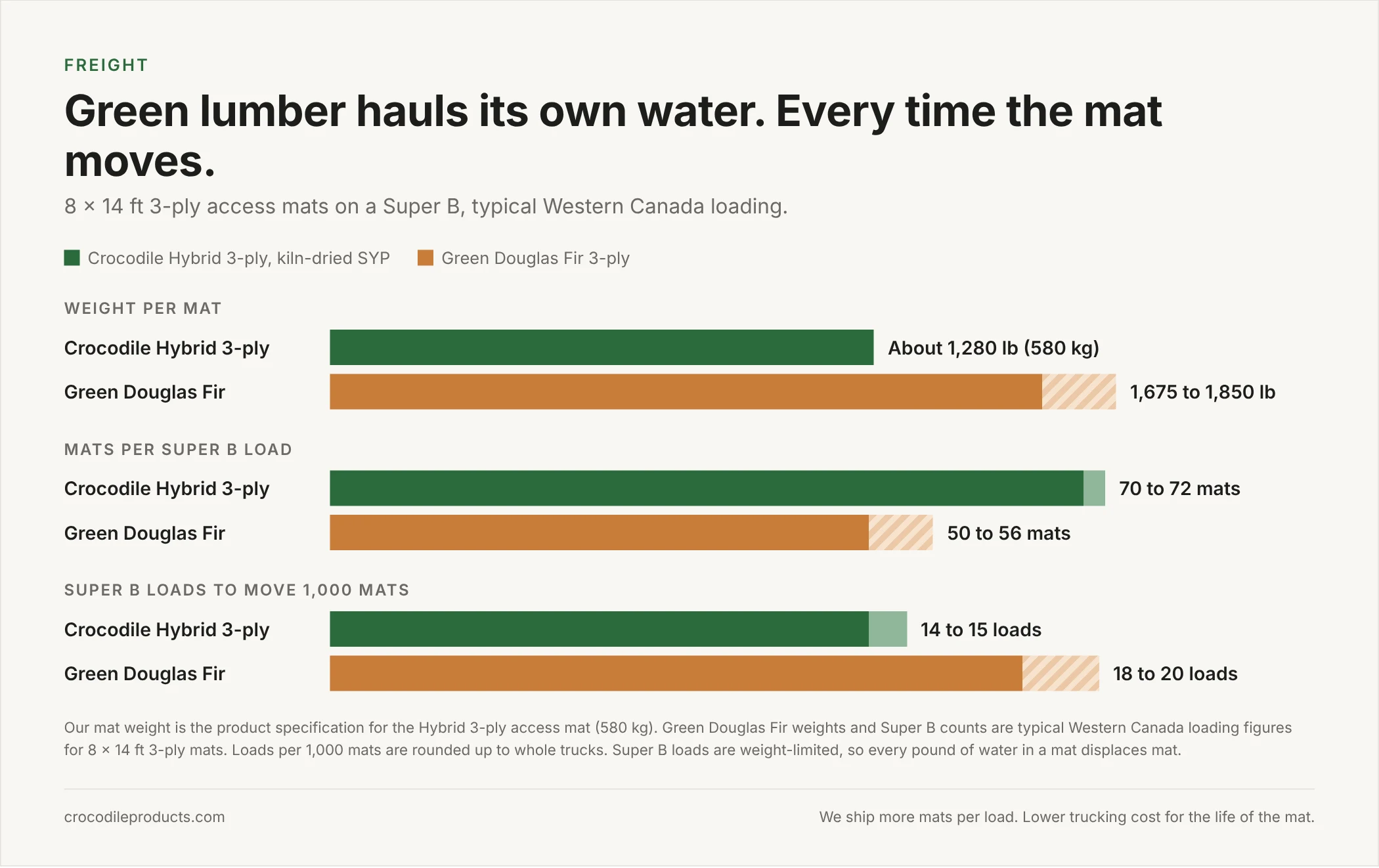
Mat weight, 8 x 14 ft 3-ply | About 1,280 lb (580 kg) | About 1,675 to 1,850 lb | 24 to 31% lighter | We ship more mats per load |
Mats per Super B load | 70 to 72 | 50 to 56 | +25 to 44% | Lower trucking cost for the life of the mat |
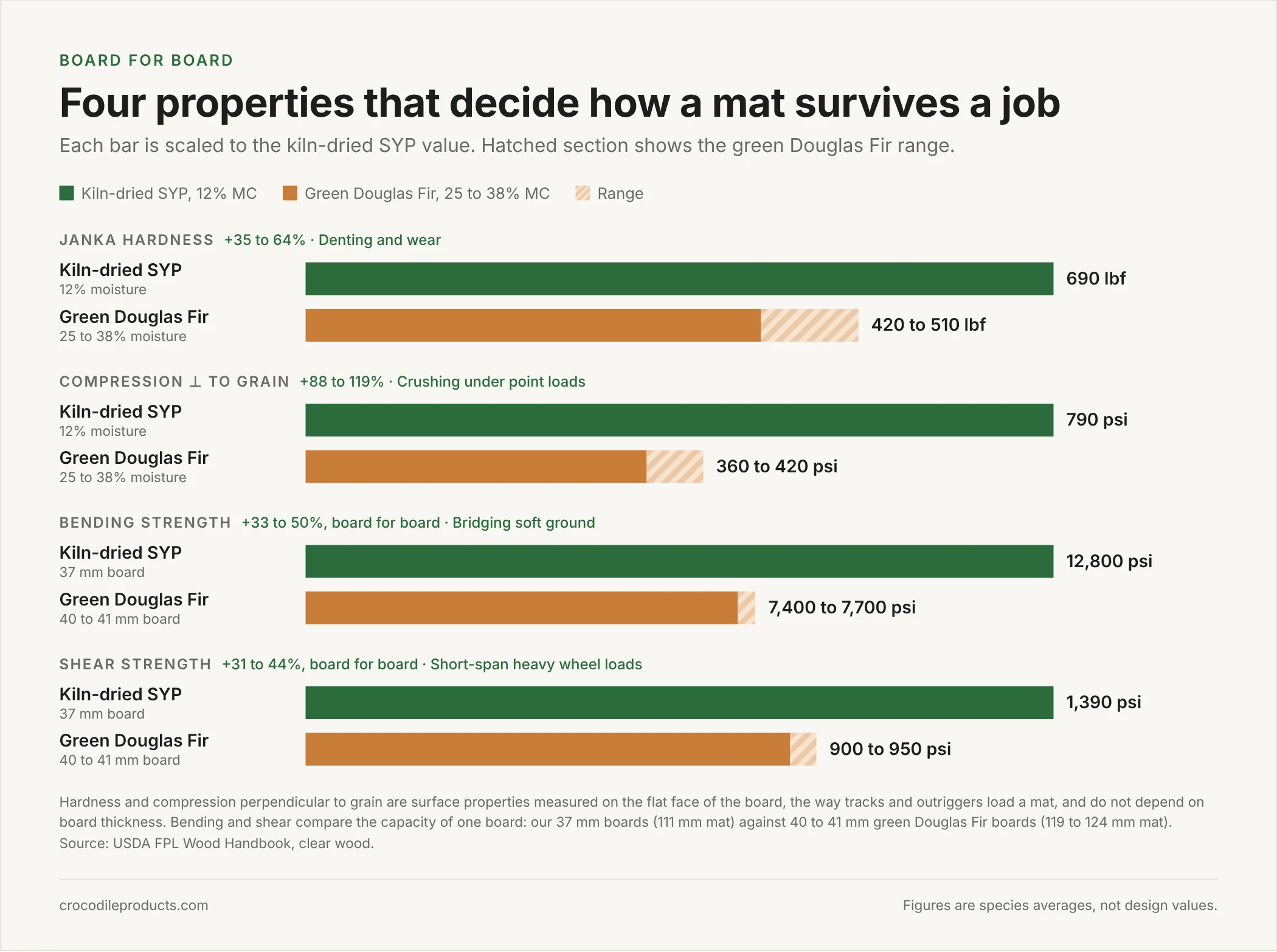
The two numbers we would point a mat buyer to first are hardness and compression perpendicular to grain. Hardness is what decides how quickly a mat surface dents, chews up and starts to hold mud under tracked equipment. Compression perpendicular to grain is what decides whether boards crush under a track pad, an outrigger float or a loaded wheel. On both, the dry mat is well ahead.
Flat, not on edge
There is a fair objection to any table like the one above, and it came from our own team. Almost all published lumber data is built around construction, where joists and studs stand on edge. In an access mat every board lies flat. Nobody publishes a table for matting.
That is exactly why we lead with hardness and compression perpendicular to grain. Both are measured on the flat face of the board, which is the face a track pad or outrigger bears on. Bending values are small clear-wood figures; laying boards flat lowers bending capacity, but it lowers it equally for both mats, so the comparison between them holds.
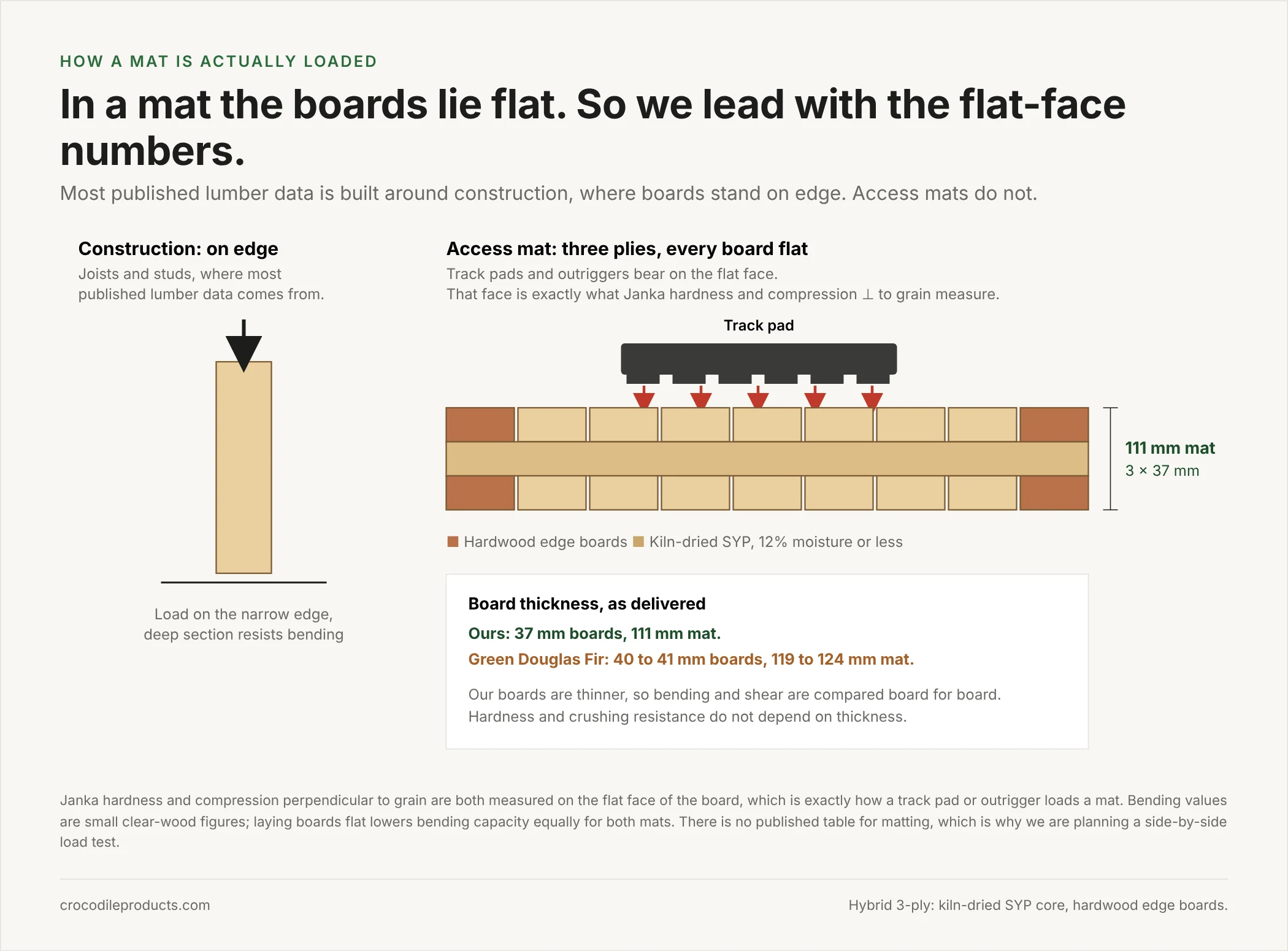
Three plies, every board flat. Tracks and outriggers load the face of the board, which is what Janka hardness and compression perpendicular to grain measure.
The truck is the other half of the story
A green mat carries its own water, and Super B loads are weight-limited, not space-limited. Every pound of water in a mat is a pound of mat that cannot go on the truck. A Super B hauls 70 to 72 of our mats against 50 to 56 green Douglas Fir mats; with the heaviest, greenest lumber, the count drops further still.
That gap is not paid once. It is paid on delivery, on every move between locations, and on the return to the yard. To move 1,000 mats takes 14 to 15 Super B loads of ours, against 18 to 20 loads of green Douglas Fir. Over the working life of a fleet that moves several times a season, the difference in trucking alone is significant.
What this comparison is not
We would rather you heard the limits from us than from a competitor.
These are clear-wood figures. Handbook values come from small, defect-free specimens. Real boards have knots and grain deviation, in both species. They are species averages, not design values, and not results of tests on finished mats.
Mats in service do not stay at delivery moisture. A mat gradually takes on or loses moisture to match site conditions. Our mats start dry; a green mat starts wet. Over a season in wet ground, the gap narrows.
None of these numbers captures field life. How a mat survives repeated moves, freeze and thaw, and seasons of tracked equipment is something only time on site, or a proper load test, can answer.
Coming next: a side-by-side load test
Published numbers can only take this so far. The real answer is to put the two mats under the same load and measure what happens. We are planning a side-by-side test: one of our Hybrid 3-ply mats and one green Douglas Fir mat, same span, measuring deflection, failure load and indentation under a track pad. When we have the results we will publish them here, whichever way they fall.
Getting started
If you run Douglas Fir mats today and want to see the difference for yourself, ask us for the one-page comparison sheet, the product specification behind our mat weight, or a trial load. Tell us the ground, the equipment and the quantity, and we will come back with a recommendation and a quote.
See the Hybrid 3-ply access mat · Ask for the paper
Basis: SYP values are published USDA Forest Products Laboratory Wood Handbook figures at 12% moisture content for clear wood. Green Douglas Fir values are the Wood Handbook green figures for coastal and interior Douglas Fir; strength does not change further above about 24% moisture. Bending and shear compare the capacity of one board, allowing for our 37 mm boards (111 mm mat) against 40 to 41 mm green Douglas Fir boards (119 to 124 mm mat); hardness and crushing resistance are surface properties and do not depend on thickness. Janka hardness and compression perpendicular to grain are both measured on the flat face of the board. Bending values are clear-wood figures; laying boards flat lowers capacity equally for both mats. Green Douglas Fir mat weights and Super B load counts are typical Western Canada loading figures for 8 x 14 ft 3-ply mats; our mat weight is the product specification for the Hybrid 3-ply access mat (580 kg). Figures are species averages for clear wood, not design values or results of tests on finished mats.