
Yellowhead and Sunrise, Same Week. Now Count the Mats.
September 10, 2026 · By Crocodile Products
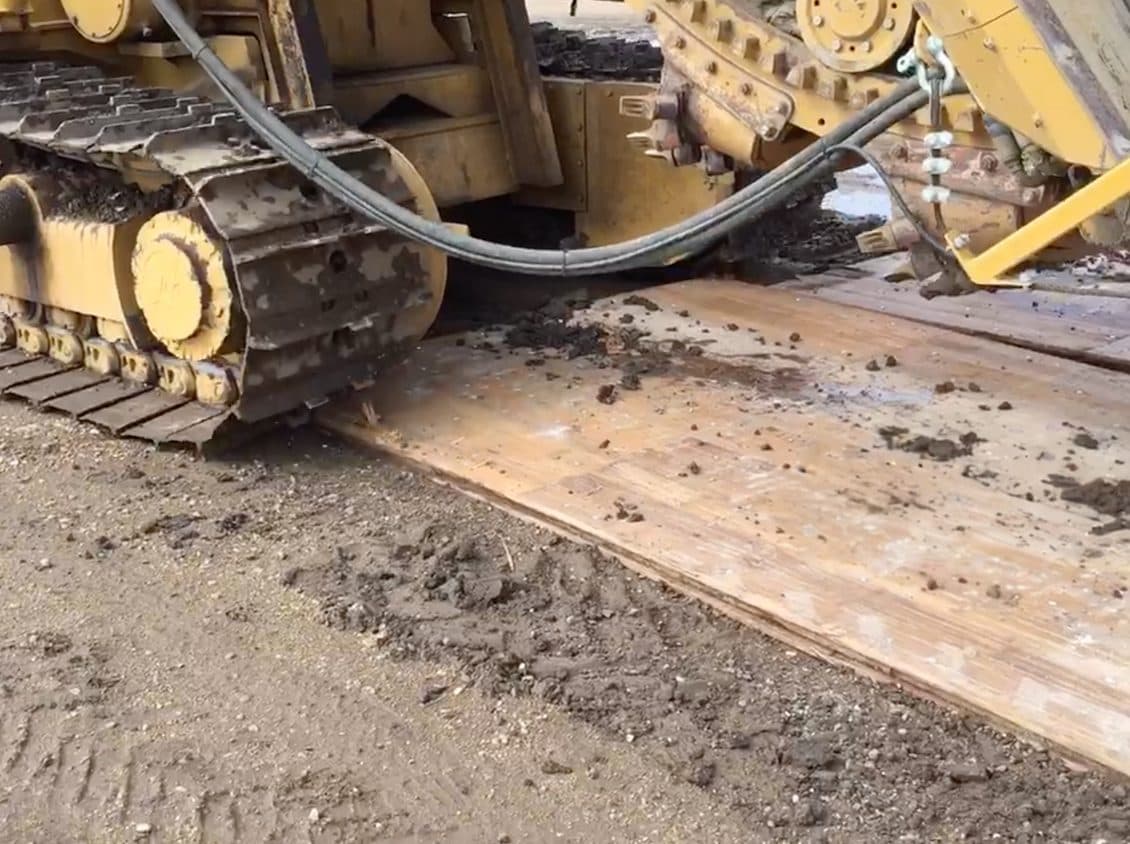
On 20 July 2026, ATCO's $2.9 billion Yellowhead Mainline received final AUC approval with construction starting immediately, and Enbridge broke ground on the $4 billion Sunrise Expansion of the Westcoast system in British Columbia. That is $6.9 billion of gas pipeline construction mobilizing at once, on fleets that are already working. Here is what that means for temporary access supply in Western Canada, and how to be ahead of it.
| $6.9B Yellowhead $2.9B + Sunrise $4B, both greenlit 20 Jul 2026 | ~375 km 235 km of 36-inch in Alberta; ~140 km of 42-inch looping in BC | 4,500+ Direct construction jobs across the two spreads | 2027-28 Yellowhead in service Q4 2027; Sunrise built through late 2028 |
One megaproject draws down the pool. Two is a squeeze.
Construction contractors for Yellowhead and Sunrise have not been publicly named. That means the supply decisions are being made right now, on both projects at once.
What 375 kilometres asks of the ground
Yellowhead runs west-central Alberta: 235 kilometres of 36-inch through Yellowhead, Lac Ste. Anne, Parkland, Sturgeon and Strathcona counties into Fort Saskatchewan, with one compressor station, in service Q4 2027. Sunrise adds roughly 140 kilometres of 42-inch looping in 11 segments on the Westcoast system in BC, from northeast of Prince George down toward the Fraser Valley, plus four new compressor stations and upgrades at 11 existing ones, built through late 2028 with two temporary camps near Mackenzie and Powder King.
On spreads this long, temporary access is a consumable: right-of-way access across soft and wet ground, shoo-fly detours, sideboom and crane pads at crossings and tie-ins, laydown at compressor stations, pipe stockpile yards, and the haul roads between all of it. Both schedules run through spring breakup, adding to mat demand through the March to early June window.
Why supply tightens from here
Mats committed to a megaproject leave the regional pool for the life of the job, and they do not come back until the right-of-way is reclaimed. Two spreads are now mobilizing at once, and fleet operators were already reporting rising mats-on-rent and production-constrained mat supply to investors this spring.
The queue behind them is real. On 2 July 2026 Alberta submitted the West Coast Oil Pipeline, roughly 1,250 kilometres from Bruderheim to a British Columbia deepwater port, to the federal Major Projects Office, with a listing decision expected this fall. If it advances, three megaprojects will be bidding for the same fleets, the same trucks and the same mats.
How the mats will move. On projects like these, matting stages are awarded by the owner or project manager to matting service providers, stage by stage, and more than one provider typically wins. Contractor and stage awards are not yet public on either project. Supply arranged with the fleets now is scheduled production; supply arranged after the awards is whatever the market has left.
Where Crocodile fits
This is not a pitch to replace your wood mat fleet. We offer committed additional capacity for when the pool tightens. The lead product is our 3 ply bolted access mat, 8x14, supplied containerized on scheduled production. The Crocodile Products production standard is our Solid Top Solid Center (STSC) Hybrid mat, built for maximum shear and loading strength: a true hybrid, with the four 14' edge boards in dense hardwood. Complementing this prime mat is our engineered bamboo 8x14 access mat, independently lab tested and documented, for compacted access roads, staging yards and even crane pads.
Crane mats do the lifts. Access mats do the kilometres.
On a pipeline spread, the crane pads are discrete: crossings, tie-ins, the compressor stations. The access requirement is linear, and it runs with the whole job.
The workhorse: the three-ply access mat
Every day of a 235-kilometre Alberta spread, or an 11-segment BC looping program, moves side booms, dozers, tracked hoes, wheel loaders and cranes across ground that was farmland or bush the week before. That iron runs corked up or on ice lugs through the cold months, and wheel loaders run aggressive studded tire chains that many crews never remove. The point loads under that steel are what chews mats up. Crocodile supplies a premium STSC with dense hardwood 14' top and bottom edge boards, for maximum durability.
Where engineered bamboo earns its place
Said straight, because your engineers will ask: the 2-3/8" engineered bamboo access mat is not the mat for pipeline iron on soft ground. It deflects more than a three-ply under those point loads. Its duty is well-compacted access roads, staging and laydown areas and yards, where its consistency, light weight and documentation work hardest.
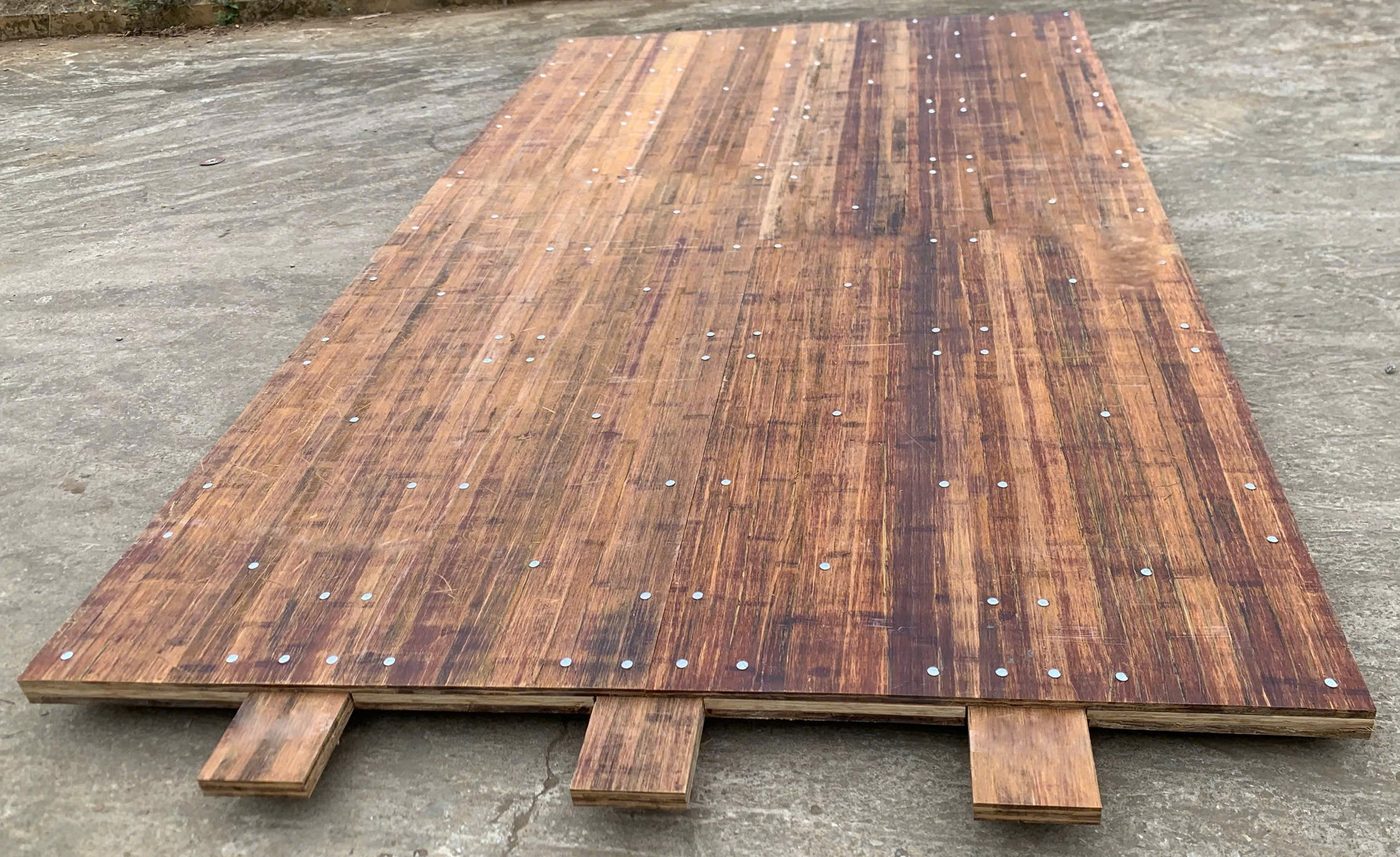
The engineered bamboo 8x14 access mat, 3 fingers at standard spacing: strand-woven laminations, consistent from the first mat in the order to the last.
The 8" bamboo timber mats are a different conversation: load-tested to destruction as finished mats, they carry the compressor stations and heavy lifts on both projects. Available 40" and 48" wide in lengths from 16' to 19'-6". Tested as finished mats by IBST, the 40" x 16'-5" x 8" mat carried 624 kN without failure (BC.120624-F.01); the 48" x 19'-8" x 8" mat reached 480 kN ultimate (Feb 2026); the 6" version tested 336 kN ultimate. Full reports supplied with quotation.
Crocodile Products covers the spread: STSC access mats for the right-of-way, 8x14 bamboo mats for compacted roads and staging areas, and 8" bamboo timber mats for the heavy lifts. One documentation standard throughout.
Everything the spread needs, one supply line
| Product | Description | Application |
|---|---|---|
| 3 ply 8x14 | Bolted 2x8 construction; hybrid, with 4 hardwood edge boards | Pipeline construction |
| Bamboo 8x14 | Available in 2 thicknesses: 2-3/8" and 2-3/4" | Compacted access roads, staging areas and laydown yards |
| Timber mats | Bamboo, 40" and 48" wide; lengths of 16' to 19'-6" | Compressor stations and heavy crane lifts |
| Rig mats | Steel frame with hardwood blocks; all 4 beam, in 8x20, 8x30 and 8x40 | Drilling pads |
| Pipe skids | Laminated bamboo pipe skids and dunnage | Pipe stringing, camps and pipe yards |
| Specialty | Rail ties, custom blocking, bamboo mini-mats | Rail sidings, mod yards and special applications |
Built in dedicated factories, not brokered
Crocodile mats are manufactured in dedicated partner factories in northern Vietnam, at the centre of a managed bamboo catchment of more than 140,000 hectares. Production runs under FSC chain of custody (C174918) with ISO 9001 quality and ISO 14001 environmental management, and finished mats are tested by independent laboratories: IBST and RIFI in Vietnam, SGS internationally. Supply to Alberta and BC is containerized, which means an order books manufacturing capacity and sails on a schedule, rather than competing for whatever regional stock is left when a megaproject mobilizes.
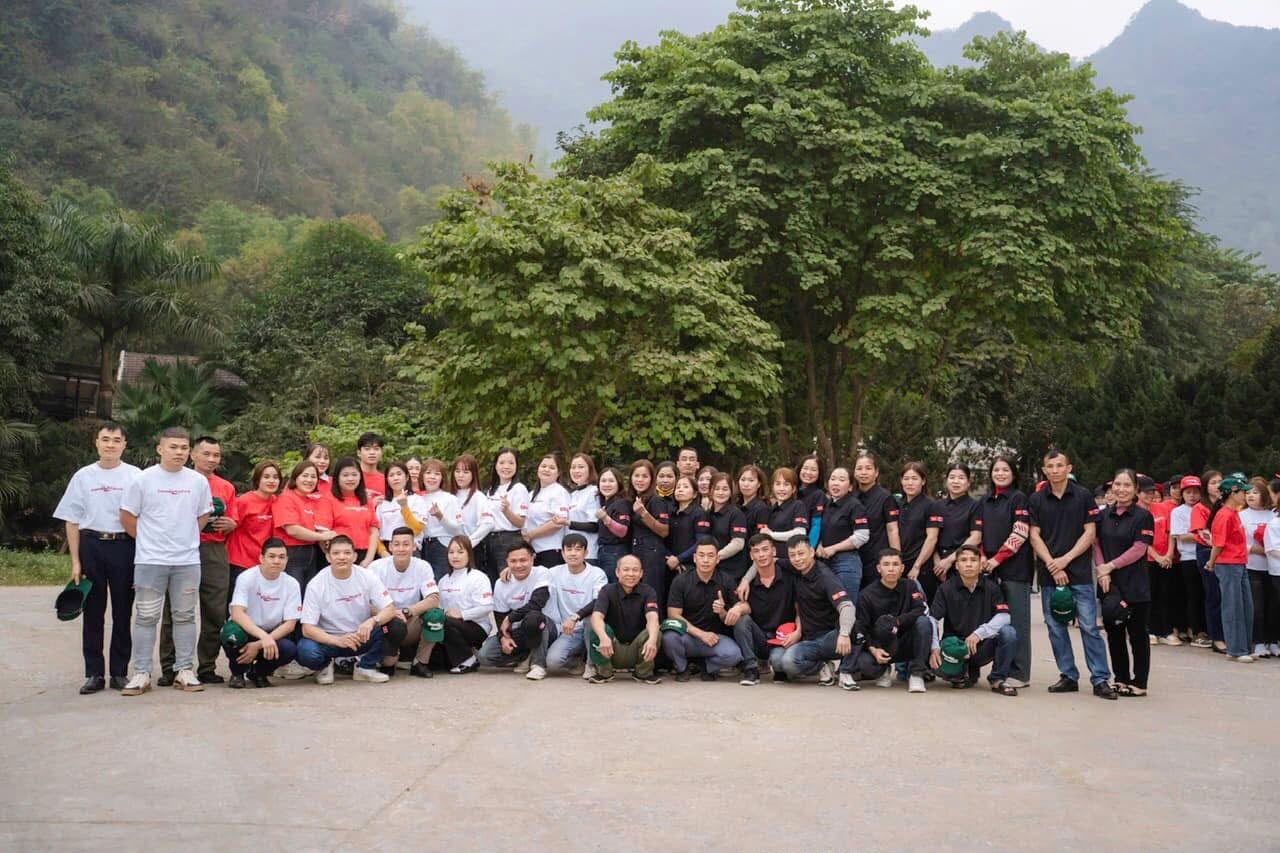
The workforce behind the mats at the Mai Chau factory.
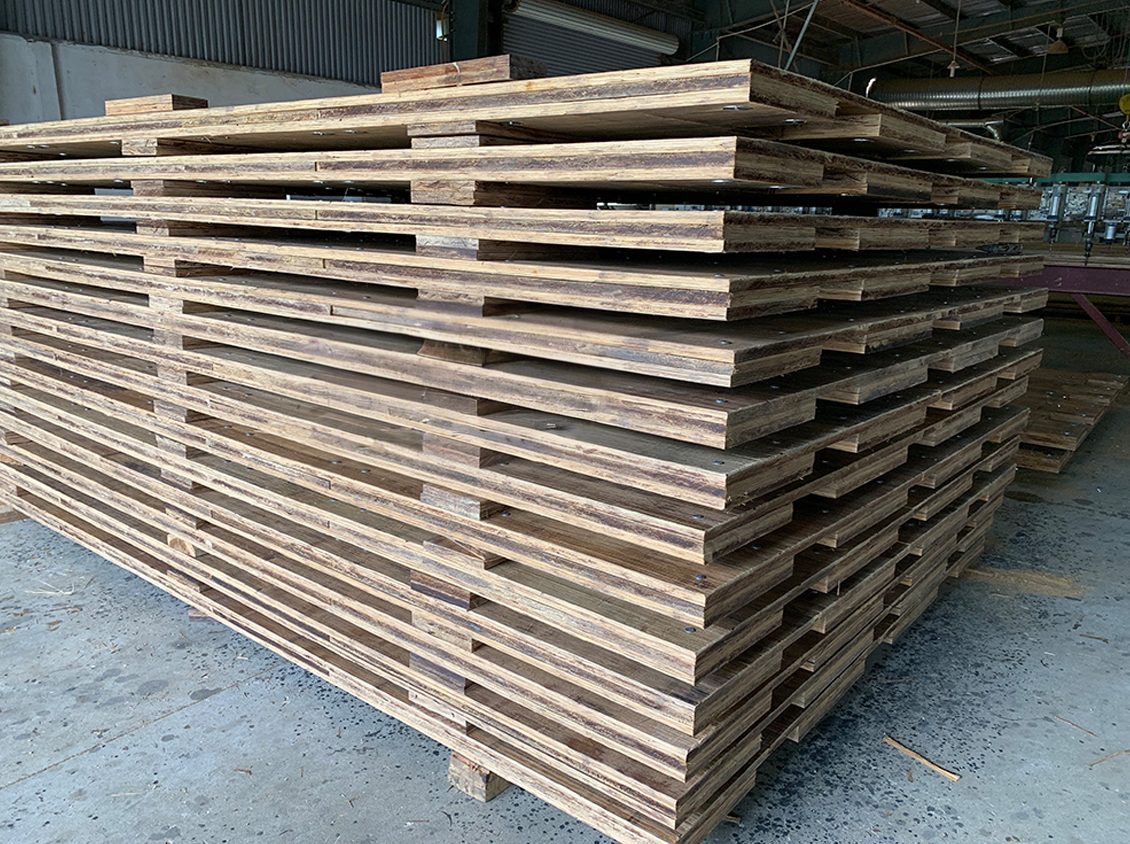
Finished 8x14 bamboo mats stacked for dispatch.
What an order buys. Scheduled production slots, full TDS per product, independent test reports attached rather than promised, and FSC documentation that flows through to your own reporting.
Sustainability you can file, not just say
Megaproject owners report their supply chains now. A mat that arrives with documentation is worth more than a mat that arrives with a slogan.
Bamboo is a grass. Mature culms are harvested on a four to five-year cycle and the plant regrows from its root system, so there is no clear-felling and no decades-long replanting wait: compare 80 or more years to grow a tropical hardwood sawlog. The bamboo behind Crocodile mats comes from a managed catchment, and every mat carries FSC chain-of-custody documentation (C174918) from that source to your yard.
When your ESG or procurement team asks for documentation, we hand over source documents: the FSC chain-of-custody certificate from catchment to delivery, ISO 14001 certified environmental management in production, ISO 9001 quality management, and the independent laboratory reports behind every load figure we quote. We do not print headline carbon claims we cannot hand you the workings for. Sustainability copy in this industry is full of numbers that do not survive an audit; ours are supplied as source documents.
Both projects run under public commitments and Indigenous partnership frameworks, and their owners report supply-chain sustainability in detail. ATCO has named ongoing contracting opportunities with Treaty 6 Nations on Yellowhead; on Sunrise, 38 BC First Nations hold a 12.5 percent stake in the Westcoast system and Enbridge reports more than $52 million already spent with Indigenous businesses on the program. Temporary works are part of that reporting. A documented, rapidly renewable, chain-of-custody-certified mat gives the contractor a line item that helps the report instead of complicating it.
The routes cross living ground. The ground remembers.
Most of the Yellowhead corridor is agricultural land; Sunrise runs through BC forest and interior valleys. What happens under the mats is now studied, regulated and reported.
What the research shows
University of Alberta researchers have measured what industrial traffic does to prairie soils, and what matting changes. In a peer-reviewed Alberta study (Najafi et al., Environmental Management, 2019), sod-stripped access routes showed 53 percent greater soil compaction and half the organic matter of undisturbed ground, while matted routes showed minimal soil property changes and largely unaffected vegetation; the authors recommend access matting as a best management practice during industrial disturbance. Follow-up work adds a practical rule: keep mats on moist soils for limited durations, and plan the access, do not improvise it.
What the ground looks like when the mats come up
Our team has watched the same thing happen on job after job, including a 75,000-mat transmission line spread: when the mats are lifted, the right-of-way greens up, and the strongest regrowth runs exactly along the tire-tracking lines where the wheel loaders and trucks ran hardest. The field explanation from agronomists: the mats block sunlight and most airflow, knocking back weeds beneath them, and the die-back feeds the soil, so the resilient grasses green up fastest where pressure was highest. The science is still being studied; the pattern repeats across sites and seasons, and it squares with the research above.
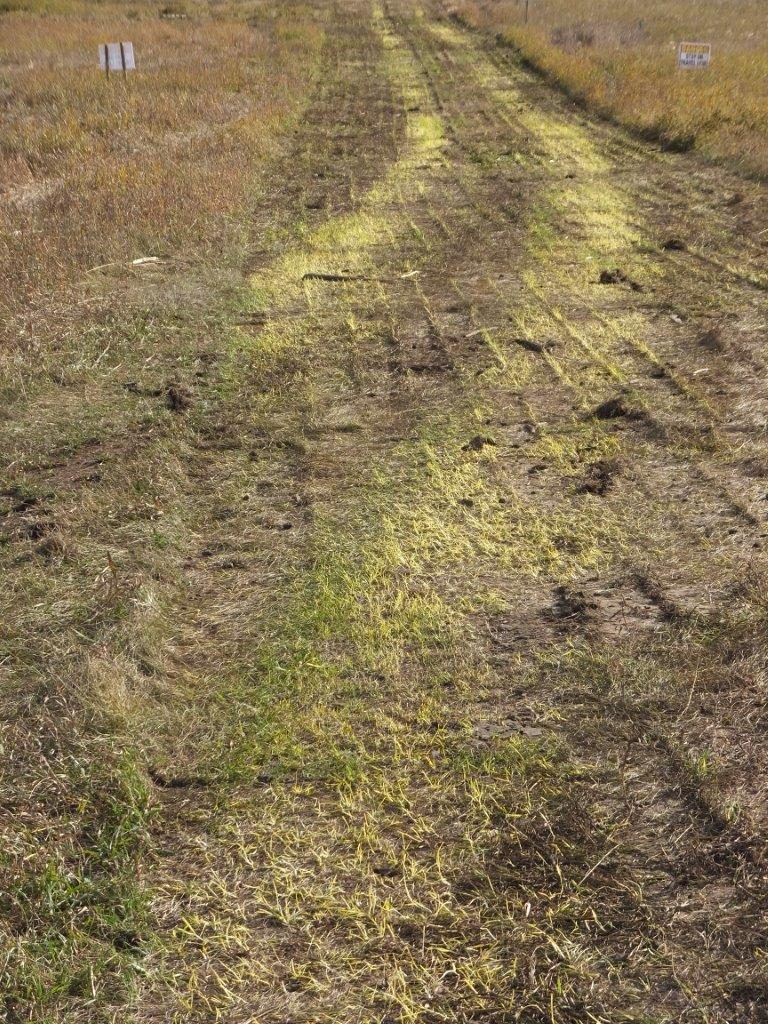
Green growth after mat removal on a 75,000-mat transmission spread; strongest regrowth along the tire-tracking lines.
The biosecurity duty most spreads discover late
Clubroot has been a declared pest under Alberta's Agricultural Pests Act since 2007, and the provincial Clubroot Management Plan explicitly names energy, pipeline and construction companies operating on agricultural land: prevent spread, clean equipment leaving infested sites, avoid traffic in wet conditions, and carry clubroot protocols for staff and contractors. Enforcement sits with municipal agricultural fieldmen, county by county, across exactly the kind of cropland the Yellowhead corridor crosses. Planned matted access is part of how a spread demonstrates that discipline; we keep the reference file on Alberta's clubroot rules current and supply it on request. The Crocodile STSC Hybrid 3 ply access mat and our bamboo 8x14 mat are fast and efficient to clean, saving both time and money as the mats move between territories.
In permits, environmental protection plans and the academic literature, the term of art is low-disturbance construction. That is the job matting does: it is not an accessory to the spread, it is the layer that lets heavy work happen on living ground and hand it back.
The numbers are tested. Ask for the paper.
The engineered bamboo range: strand-woven full-size sections tested to destruction by independent laboratories. 3 ply access mat TDS supplied with quotation.
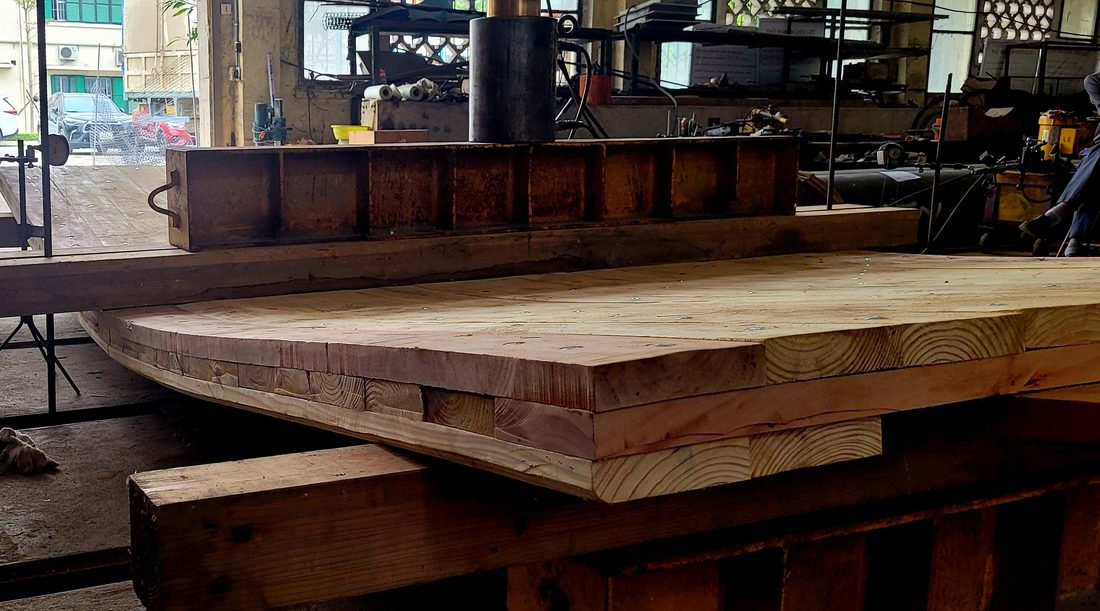
Full-scale load test: the STSC hybrid 3 ply deflecting under point load.
| Property | Result | Basis |
|---|---|---|
| Bamboo timber mat 6", ultimate | 336 kN | CP22CMB002, 16'-5" x 40" x 6" (5000x1000x150 mm) · IBST |
| Bamboo timber mat 8", max carried | 624 kN, no failure | 16'-5" x 40" x 8" · IBST BC.120624-F.01 |
| Bamboo timber mat 8", ultimate (Fmax) | 480 kN | 19'-8" x 48" x 8" (6000x1227x200 mm) · IBST, Feb 2026 |
| Bamboo access mat bending, ultimate | 31.8 kN | 2-3/8" (60 mm) finished access mat, 3-point · IBST BC.100625-G.02 |
| Full-area compression | 2,900 kN, no failure | ~18" (464 mm) specimen · IBST BC.241125-G.01 |
| Concentrated patch load | 850 kN to failure | IBST BC.241125-G.02 |
| Bending strength (MOR) | 137.8 MPa | EN 408 specimen · IBST |
| Stiffness (MOE) | 21.8 GPa | EN 408 specimen · IBST |
| Compression | 87.4 MPa | ISO 13061-5 · IBST |
| Surface hardness | 14,816 N | RIFI Vietnam |
| Reaction to fire | Class Efl | EN 13501-1 · SGS |
Straight with you on status. These are independent test results: finished mats loaded to destruction by IBST Vietnam, with ISO 23478:2022 material characterisation on file (IBST report BC.070726-G.01, July 2026). Working loads are set per application, and final mat sizing is always confirmed by site-specific ground-bearing calculation. Full reports supplied with quotation.
Next steps
For rental fleets. A committed container programme scheduled ahead of contractor awards, so megaproject demand does not strip your yard of rentable stock.
For contractors and EPCs. TDS pack and quotation per product, sized to spread requirements, with test reports attached rather than promised.
Every claim in this article is documented. Ask for the paper. Quote requests via crocodileproducts.com, answered within 24 hours.
Commercial overview, not engineering advice. Final mat selection is confirmed by site-specific ground-bearing calculation. Test values are ultimate results as tested by IBST Vietnam; working loads by application. Research cited compares matting with no matting; it is not a material comparison. Project facts: Alberta Utilities Commission decision and ATCO news release, 20 July 2026; Alberta Major Projects registry; Canada Energy Regulator project record, Enbridge Sunrise fact sheet and Natural Resources Canada release, 20 July 2026; Exchange Income Corporation Q1 2026 earnings call; Government of Alberta submission to the federal Major Projects Office, 2 July 2026. Citations supplied on request.